Friday, September 11, 2026 / by Vic Markarian
Data Centers Are Moving Closer to Homes. What Could That Mean for You?
Data Centers Are Moving Closer to Homes. What Could That Mean for You?
Data centers probably aren't something most people think about when they’re buying or selling a home.
School districts? Definitely.
Commute times? Of course.
How close you are to shopping, parks, and family? Absolutely.
A large building filled with computer servers nearby? Probably not at the top of the list.
But that may be changing.
As data centers expand into more communities across the country, they’re becoming something homebuyers and homeowners may need to consider. And that raises some reasonable questions:
Could a data center affect home values? What about noise? Electricity costs? Infrastructure? And should buyers be concerned if one is planned nearby?
The answer isn't simply "yes" or "no." The impact can depend heavily on the location, the size of the facility, how close it is to homes, and how the project is designed and regulated.
Here's what the data tells us so far.
Data Centers Are Showing Up in More Communities
The growth has been pretty dramatic.
According to Realtor.com, in 2015 there were only about a dozen ZIP codes in the country with a large data center, defined as a facility with at least 50 megawatts of capacity.
By the first half of 2026, that number had climbed to more than 100 ZIP codes, with the total projected to increase further by the end of the year.
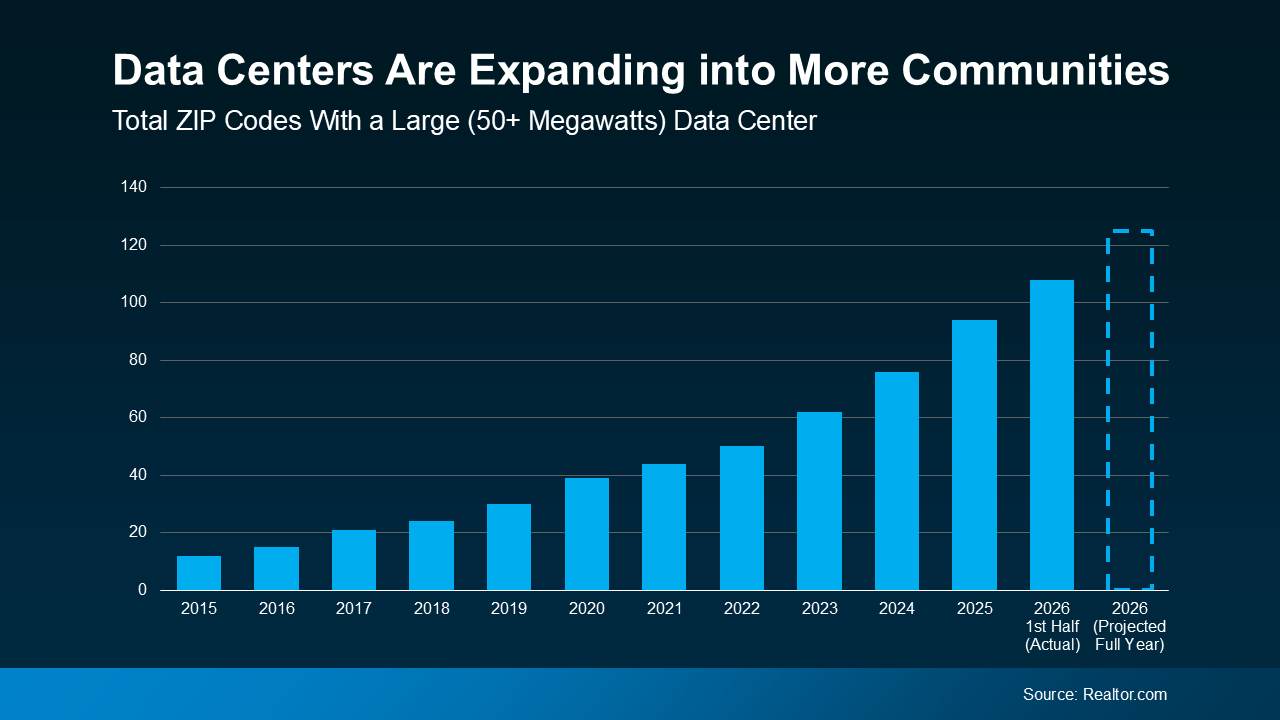
That's a major increase in just over a decade.
A lot of that expansion is happening in states such as Texas, Virginia, Georgia, Pennsylvania, Ohio, Utah, Illinois, Arizona, Indiana, and Nevada.
And that's why data centers are becoming a real estate issue.
As more facilities are built, more buyers will encounter them during a home search. Homeowners may also find themselves living near a proposed project they never expected to see in their neighborhood.
So naturally, the next question is:
Could a Data Center Affect Home Values?
This is probably the biggest concern for homeowners.
If a large data center is built nearby, does that automatically mean nearby homes will be worth less?
So far, the data doesn't support that conclusion.
Researchers have compared ZIP codes with large data centers to similar communities without them. According to recent HousingWire reporting, home values in those data-center ZIP codes generally tracked their comparable communities, without statistically meaningful gains or losses.
There was some evidence of a modest increase in listing prices around the time certain facilities opened, but the overall results don't show a consistent pattern of data centers either driving home values up or pushing them down.
That's an important distinction.
A data center nearby doesn't automatically make a home less valuable.
At the same time, it would be a mistake to assume every property will respond the same way.
A facility located several miles away is very different from one directly behind a residential neighborhood. A modern facility with significant setbacks and limited noise may have a different impact than a project involving substantial construction, generators, substations, or heavy truck traffic.
In other words, proximity and the specific project matter.
There Can Be Benefits... and Tradeoffs
A major development like a data center can bring some positives to a community.
It can also create concerns.
Potential benefits
Economic activity.
Large data-center projects can represent significant investment and can create jobs directly and indirectly.
Infrastructure improvements.
Depending on the project, new roads, fiber networks, electrical infrastructure, and other improvements may be required to support the facility.
Additional tax revenue.
Large developments can contribute substantial property tax revenue, potentially providing additional resources for local governments and public services.
More development.
A data center can sometimes be part of a larger investment trend in an area, particularly in communities already attracting technology, industrial, or commercial development.
But there are tradeoffs buyers should understand.
Potential concerns
Noise.
Cooling equipment, backup generators, construction activity, and truck traffic can all create noise. How noticeable it is depends heavily on the facility and its distance from nearby homes.
Changes to the surrounding area.
Large buildings, electrical substations, transmission infrastructure, and other equipment can change the appearance and character of an area.
Electricity demand.
Data centers can consume enormous amounts of electricity. That has led to growing discussions about grid capacity and whether increased demand could eventually affect utility costs.
Water use.
Some data centers also require significant amounts of water for cooling, although the amount can vary considerably depending on the technology being used.
So the question isn't necessarily whether data centers are "good" or "bad."
It's what does this particular project mean for this particular community?
Could Data Centers Affect Your Utility Bill?
This is another question homeowners are beginning to ask.
Data centers can require massive amounts of electricity, so it's reasonable to wonder whether that additional demand could eventually show up in consumers' utility bills.
But it's not as simple as saying:
"A data center moves in, therefore your electric bill goes up."
Electricity rates are influenced by many factors, including generation costs, transmission infrastructure, utility investments, regulations, and overall demand.
J.P. Blackwood, a spokesperson for the Ohio Consumers' Counsel, told HousingWire that utility rate increases generally happen gradually and that data centers are one of several factors that can contribute to higher electricity costs.
There are also efforts in different parts of the country to make large electricity users pay their share of the infrastructure needed to serve them.
So this is an issue worth watching, but it's too early to assume that every community with a data center will see a direct increase in household utility bills.
What Should Buyers Look For?
If you're buying a home, a data center probably shouldn't automatically take a property off your list.
But it should become part of your due diligence if there's one nearby or a project has been proposed.
A few things are worth checking:
- How close is the facility to the property?
- Is it already operating or still being proposed?
- What is the construction timeline?
- Will there be new substations or transmission infrastructure?
- What kind of cooling system will be used?
- Could there be noticeable noise?
- Are additional phases planned?
- What is the local government's position on the project?
- Could the surrounding property be developed further?
The goal isn't to scare yourself away from a property.
It's to understand what you're actually buying.
What About Homeowners Who Are Selling?
If you're selling a home near a data center, don't automatically assume it will hurt your property's value.
But you should expect that some buyers may have questions.
That's where preparation matters.
Knowing the facts about the facility, including its location, size, construction schedule, noise considerations, and future expansion plans, gives you a much better position to answer those questions.
And if the data shows the facility hasn't had a measurable negative effect on comparable home values, that's useful information too.
The key is to deal with the facts rather than assumptions.
What This Could Mean for Los Angeles
This is becoming particularly interesting in Los Angeles.
Data centers are already part of the commercial and industrial real estate landscape in areas around Los Angeles, and new projects are bringing more attention to questions about electricity, water, industrial land, zoning, and neighborhood impacts.
That means this isn't just a technology story.
It's becoming a real estate story.
For buyers, it could become another factor to investigate when evaluating a neighborhood. For homeowners, proposed data-center projects could influence how they think about future development around their property. And for investors and commercial property owners, access to power and suitable zoning could become increasingly important when determining what certain industrial properties are worth.
The bigger question may ultimately be less about whether data centers are coming and more about where they're going, and what gets built around them.
The Bottom Line
Data centers are expanding into more communities, and that means they're going to show up more often in conversations about real estate.
So far, the evidence doesn't show that simply having a large data center nearby automatically causes home values to rise or fall.
But that doesn't mean buyers and homeowners should ignore them.
Location, distance, noise, infrastructure, utility demand, zoning, and future development all matter.
If there's a data center operating, or being proposed, near a home you're considering, take the time to understand the project before making a decision.
Because when it comes to real estate, what's happening around a property can be just as important as what's happening inside it.